

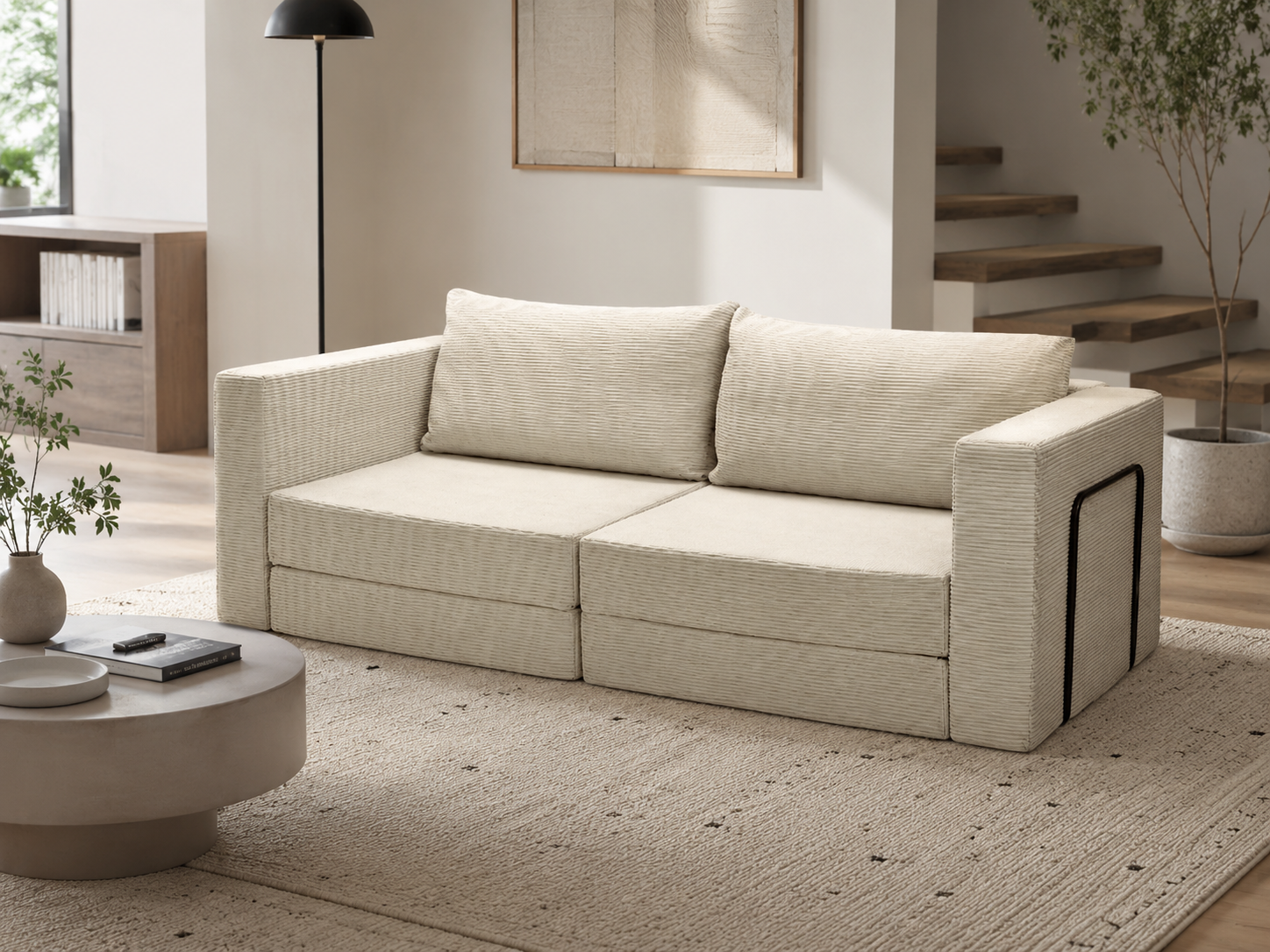
Modular Foam Sofa Guide: How to Build Your Perfect Living Room Setup
The idea of a "perfect living room" used to mean picking the right sofa from a catalogue and hoping it fit. It rarely did — not quite, anyway. Too long for the wall, too short for the room, wrong configuration for the way you actually live. The modular foam sofa changes that equation entirely.
Modular design puts the configuration in your hands. You decide the shape, the size, the layout — and you can change your mind later without buying new furniture. This guide explains how it works, why it matters, and how to think about building a setup that actually fits your space and your life.
What Is a Modular Foam Sofa?
A modular foam sofa is a seating system made of individual sections — called modules — that connect together in different configurations. Instead of buying a fixed two-seater or a predetermined corner unit, you buy the pieces that make sense for you and arrange them the way your room demands.
The modules typically include: a standard seat section, a corner piece, an armrest unit, a chaise extension, and sometimes an ottoman or a sleeper section. Each piece is designed to connect seamlessly with the others, creating a unified look regardless of how you combine them.
The foam element refers to the internal cushioning system. A quality foam sectional sofa uses high-density polyfoam, HR (high resilience) foam, or a combination of both — sometimes with a memory foam comfort layer on top. The sofa foam determines how the piece feels day to day: how supportive the seat is, how well it holds its shape over time, and how comfortable it stays after years of use.
What makes a modular system different from simply buying a large sofa is flexibility. A fixed sofa is committed to its shape from the moment it arrives. A modular foam sofa can be reconfigured when you move, rearranged when your household changes, or extended when you need more seating. The sofa grows with you instead of becoming obsolete.

Benefits of Modular Design
There are practical benefits and less obvious ones. Both matter.
It fits the room — not the other way around. Standard sofas come in preset sizes. If your wall is 270 cm and the sofa is 260 or 290, you compromise. A modular system lets you hit the exact dimensions your space needs, adding or removing sections until the configuration is right.
It moves with you. Anyone who has tried to get a large sofa up a narrow staircase or through a tight doorway understands the problem. Modular pieces are smaller individually, which makes delivery and relocation dramatically easier. A foam sectional sofa that arrives in six manageable sections is far less stressful than one enormous fixed unit.
It adapts to how you live. A studio apartment today might be a two-bedroom flat in three years. A living room used mostly for quiet evenings might need to accommodate fifteen people for a gathering next month. Modular furniture doesn't ask you to choose one configuration forever. You rearrange, extend, or reduce as your life changes.
It encourages personalization. This is the benefit people underestimate most. Choosing your own configuration — the number of seats, the placement of the chaise, whether you add a sleeper section — means the result reflects actual decisions you made about your space. It's the difference between furniture that happens to be in your home and furniture that belongs there.
It's cost-efficient over time. Rather than replacing an entire sofa when your needs change, you add a module. A modular sofa bed section can be added to an existing configuration when you need a guest sleeping option. An ottoman can be added when you want more lounging space. The system scales up without starting over.
Fixed vs. Modular: Which Is Right for You?
A fixed sofa isn't inherently worse than a modular one. For some situations and some people, it's the better choice. Here's how to think about it honestly.
Choose a fixed foam sofa if:
You have a clear, stable space where the sofa will live for years without moving. You know exactly what size and shape you want. Your budget is tighter — modular systems typically cost more per module than a comparable fixed sofa. You prefer a simpler purchasing decision.
Choose a modular foam sofa if:
You rent, move frequently, or expect your living situation to change. Your room has an unusual shape — an alcove, an offset corner, an awkward wall length — that standard sizes don't accommodate well. You want flexibility to add a modular sofa bed function later without replacing the whole piece. You value being able to reconfigure the layout when you redecorate or rearrange.
The key difference in sofa foam construction: fixed sofas often have more integrated cushioning because the shape is predetermined. Modular systems need each section to work both independently and as part of a larger whole, which means the foam and upholstery must meet at joins cleanly and consistently. A well-engineered modular system looks seamless when assembled; a poorly engineered one shows gaps, height variations, and mismatched fabric tension at every connection point.
How to Configure Your Modular Foam Sofa
Before you start selecting modules, a few measurements and decisions will make the process straightforward rather than overwhelming.
Measure the room, not just the wall. The sofa's footprint when you're sitting and using it is larger than the frame itself. Leave at least 45–60 cm between the sofa and the coffee table. Make sure the configuration doesn't block natural pathways through the room. If you're adding a modular sofa bed section, measure the floor space required in the extended position — typically an additional 80–100 cm of depth.
Decide on the primary function first. Is this sofa mainly for daily lounging? For entertaining? For a room that doubles as a guest bedroom? The primary use determines which modules are essential and which are optional. A household that frequently hosts overnight guests should prioritize a sleeper module. A couple who mainly watches films together needs a deep chaise before they need extra seating.
Think about traffic flow. In an open-plan space, a foam sectional sofa can act as a natural room divider — a U-shape or L-shape configuration can define the living area without walls. In a smaller room, an L-shape that follows two walls maximizes seating while keeping the centre of the room clear.
Common configurations and what they suit:
|
Configuration |
Best For |
|
L-shape (2–3 modules + corner) |
Most living rooms; good balance of seating and space |
|
U-shape (4–5 modules + corner) |
Open-plan spaces; large households; entertaining |
|
Straight + chaise |
Smaller rooms; couples; media rooms |
|
Straight + sleeper module |
Guest rooms; studios; multifunctional spaces |
Leave room to grow. One of the advantages of a modular system is that you don't have to buy everything at once. Start with the core configuration you need today and add sections later. A foam sofa base of three modules can become a full sectional over time as budget and space allow.
SEESOFA's Approach to Modularity
At SEESOFA, modularity isn't a feature added on top of a standard sofa. It's the starting point — the reason the Flow Sofa and Flowy Sofa exist as a system rather than as separate products.
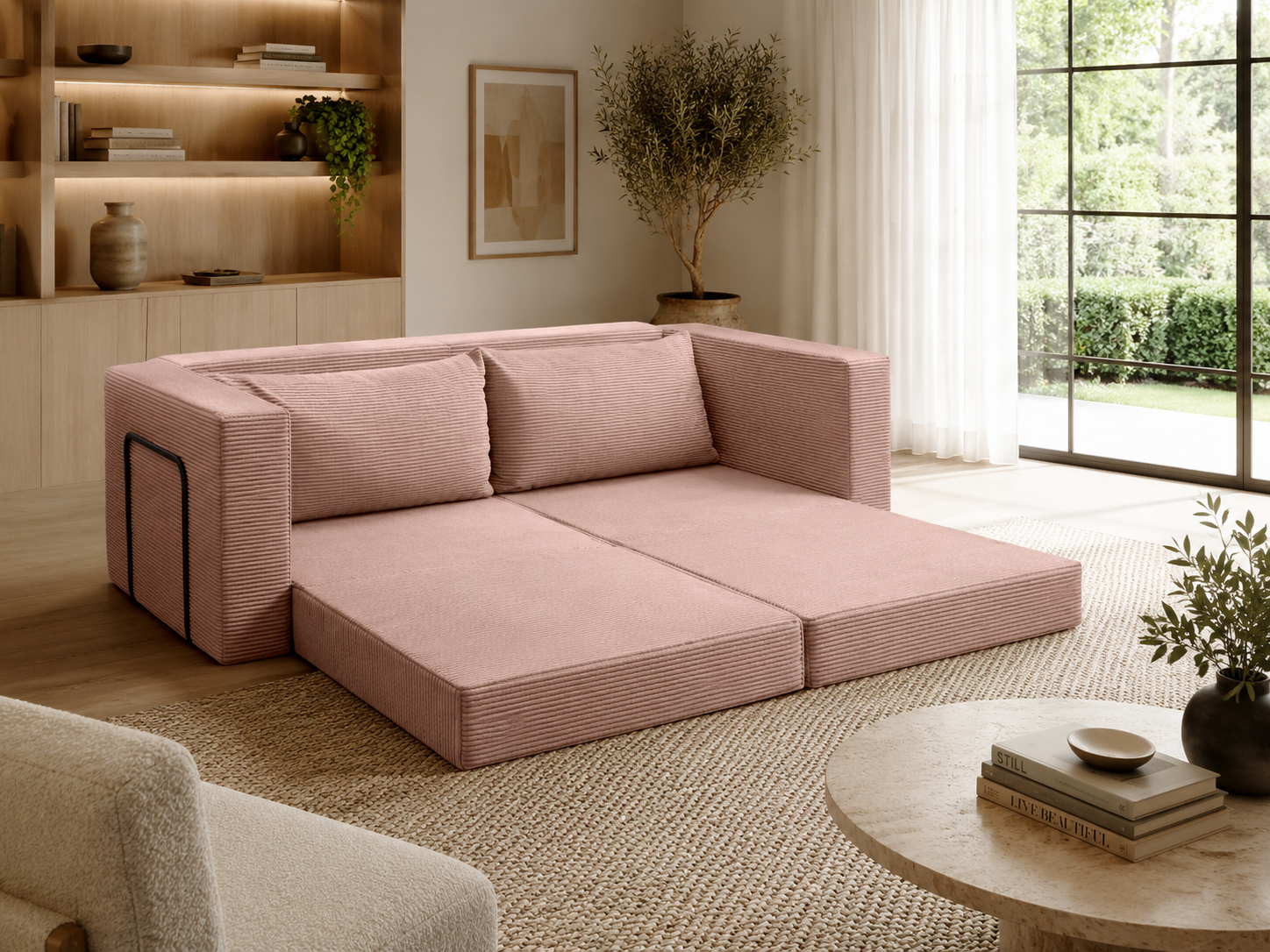
The Flow Sofa is the anchor piece. Built on a solid beech frame with corner-block reinforcement, it uses a three-layer sofa foam construction: a 40 kg/m³ high-density base, an HR foam transition layer, and a memory foam comfort surface. It functions as a standalone sofa in Full or Queen width, and converts to a proper bed via a patented single-motion glide mechanism. For anyone who needs their modular sofa bed to work as both, the Flow does neither function halfway.
The Flowy Sofa is the modular extension. It shares the same foam construction, the same fabric range, and the same leg design as the Flow — meaning the two pieces look like a considered system, not a mismatched pairing. The Flowy works as a standalone armchair-width section or as an adjoining piece that expands the Flow's seating footprint. Add one Flowy and the configuration becomes an L-shape. Add two and you're building toward a sectional.
The connection between Flow and Flowy is intentional and clean. The heights align, the upholstery meets at the join without visible tension, and the sofa foam density is matched across both pieces so the sitting experience is consistent regardless of which section you're on.
Both pieces are available in the same five fabrics — warm oat, deep slate, terracotta, sage, and charcoal — all performance-weave, stain-resistant, and machine washable via zip-off covers. Both carry the same 15-year frame warranty.
This is what a genuine modular system looks like: not a product with optional add-ons, but a considered ecosystem where every piece was designed to work with every other piece. The modular foam sofa you build with Flow and Flowy is one that reflects how you actually want to live — and one that can change as that changes.

Frequently Asked Questions About Modular Foam Sofas
What is a modular foam sofa?
It is a sofa made of separate sections that can be arranged in different layouts.
Why choose a modular foam sofa?
Because it can adapt to your room, lifestyle, and future needs.
Can a modular sofa be reconfigured later?
Yes, you can rearrange, extend, or reduce the setup over time.
Is a modular sofa good for small spaces?
Yes, especially when you choose only the modules your room actually needs.
What foam is best for a modular sofa?
High-density foam, HR foam, or a mix with memory foam works best.
Can a modular foam sofa include a bed function?
Yes, some systems include a sleeper module or sofa bed section.


Leave a comment
This site is protected by hCaptcha and the hCaptcha Privacy Policy and Terms of Service apply.