


How to Choose the Right Foam Sofa: The Complete Buyer's Guide
Buying a sofa should be simple. It rarely is.
Walk into any furniture store — or scroll through any website — and you'll quickly hit a wall of options, specifications, and marketing language designed to sound helpful while actually telling you very little. "Premium fill." "Luxurious comfort." "Engineered for support." What does any of that actually mean?
If you're looking at foam sofas and trying to figure out what separates a good one from a disappointing one, this guide will give you straight answers. No jargon, no filler. Just what you actually need to know to make a decision you won't regret two years from now.
Types of foam used in sofas
Not all sofa foam is the same. This is the starting point for everything else, because the type of foam inside a couch determines how it feels, how long it lasts, and how well it holds up to daily use. If you want a comfortable foam seat sofa, you need to understand what is hidden beneath the upholstery fabric.
|
Foam Type |
Pros |
Cons |
|
Polyurethane (Polyfoam) |
Affordable, widely available |
Low density degrades very quickly |
|
Memory Foam |
Excellent pressure relief, cozy |
Retains heat, needs a firm base |
|
High Resilience (HR) Foam |
High bounce-back, durable, airy |
Higher price point |
|
Natural Latex |
Eco-friendly, hypoallergenic |
Most expensive option |

Polyurethane Foam (Polyfoam)
Polyurethane foam (polyfoam) is the most common type found in furniture at every price point. It's made from petroleum-based compounds and comes in a wide range of densities. Low-density polyfoam is cheap, compresses quickly, and tends to go flat within a year or two of regular use. Higher-density polyfoam is significantly more durable and holds its shape far longer. When a brand doesn't specify what kind of sofa foam filling they use, it's usually this — and usually at the lower end.
Memory Foam
Memory foam is polyfoam's more pressure-sensitive cousin. It responds to body heat and weight, contouring around you rather than simply supporting you. This makes it excellent for sleeping surfaces and for people who find firm sitting uncomfortable. In furniture design, memory foam is almost always used as a top layer over a firmer base — a combination that gives you both structure and softness. A foam filled sofa with a memory foam comfort layer and a high density foam sofa core is one of the most practical configurations you'll find on the market today.
High Resilience (HR) Foam
HR foam has an open-cell structure that allows it to spring back quickly after compression. It doesn't sag the way standard polyfoam does, it breathes better, and it maintains its shape significantly longer. Many quality European manufacturers use HR foam as their standard. If you're comparing options and one specifies HR foam, that's a meaningful differentiator for anyone seeking a resilient foam sofa.
Natural Latex Foam
Natural latex foam is made from rubber tree sap and is both durable and naturally hypoallergenic. It has a slightly different feel from polyfoam — bouncier, more responsive — and it tends to be the most expensive option. It's also the most eco-friendly, which matters to a growing number of buyers. A premium foam seat sofa with natural latex cushions will likely outlast most other configurations, though the price reflects that premium raw material.
Reconstituted Foam (Chip Foam)
Reconstituted foam is made from shredded foam offcuts compressed together. It's used in the backs and arms of many budget options as a cheaper filler. In small amounts, in the right places, it's fine. As the primary material for your sofa foam, it's a major warning sign.
What makes a good foam sofa?
A good foam sofa isn't just about the foam itself. The interior components work inside a complex system. A poorly built frame or a cheap cover can undermine even excellent sofa foam filling. To find a truly reliable high density foam sofa, you have to look at the complete construction.
1. The Frame
Hardwood frames (beech, oak, ash) are the gold standard. They're strong, they don't warp with humidity changes, and they last for decades. Softwood frames (like pine) are cheaper and weaker. Engineered wood (MDF, particleboard) is often used in budget furniture — it works fine in low-stress areas but can crack at joints under repeated use. A frame that flexes when you sit on it will shorten the life of your foam filled sofa.
2. The Suspension System
Underneath the cushioning, furniture designs use either coil springs, sinuous (S-shaped) springs, or webbing.
- Coil springs give the most support and the best bounce-back.
- Sinuous springs are cheaper but highly acceptable in modern, low-profile designs.
- Pure webbing — rubber or fabric — is the least supportive option and is more likely to sag over time.
Good suspension protects the sofa foam above it from bearing load it shouldn't have to handle alone.
3. Foam Density
Density is measured in kilograms per cubic metre (kg/m³) or pounds per cubic foot (lb/ft³). For seat cushions, look for a minimum of 30 kg/m³. A genuine high density foam sofa will typically use 35–45 kg/m³ for seat cushions. Anything below 25 kg/m³ will compress and lose shape within months, turning your beautiful furniture into an uncomfortable, sagging mess.
4. ILD Rating (Firmness)
ILD — Indentation Load Deflection — measures how firm a sofa foam filling feels. Lower ILD means a softer experience, while higher ILD indicates a firmer sit. For domestic seating, an ILD of 25–35 is medium-soft, 35–45 is medium-firm, and 45+ is quite firm. Most people prefer a foam seat sofa in the 30–40 range, depending on body weight and personal comfort preferences.

Key Buying Factors
When you're standing in front of a foam sofa in a showroom — or scrolling through options at midnight — here is your practical checklist.
Ask about foam density directly. If a brand won't publish the specification, treat that as an immediate red flag. Reputable manufacturers are proud of their sofa foam filling numbers. Hidden specs usually mean the numbers aren't impressive.
Sit in it — the right way. Don't perch on the edge for thirty seconds. Sit the way you actually sit at home. Cross your legs. Slouch. Shift around. A foam sofa that feels great upright but uncomfortable in every other position is going to frustrate you quickly.
Check the back cushions too. Seat cushions get the most attention, but back cushions affect comfort just as much during long movie nights. Fiber-filled backs feel soft initially but flatten significantly. Foam-filled backs hold their shape better. The best high density foam sofa designs use engineered foam in both seat and back cushions — firmer in the seat, softer against your back.
Examine the legs and base. Legs should be solid — hardwood or heavy metal — and firmly attached, not wobbling. Check underneath: does the frame look substantial? A foam seat sofa carries significant load over years of use, and the legs take the brunt of that force.
Think about your household. A home with children, pets, or frequent guests has different needs than one where the furniture is mostly decorative. For high-traffic living rooms, choosing a high density foam sofa with durable upholstery isn't a luxury — it's a cost-saving decision over time.
Check the warranty. Frame warranties of 10–15 years signal real confidence in construction. Foam and fabric warranties of 2–5 years are standard. No meaningful warranty is information too.
Are foam sofas durable?
The honest answer: it depends entirely on the quality of the sofa foam, and that quality varies enormously across the industry.
A low-density sofa foam filling in a budget couch will begin to show visible compression within 12–18 months of daily use. The seat develops a permanent dip where you always sit. The cushions look flat, tired, and worn out. This isn't a failure of foam as a material — it's a failure of using the wrong grade of material for heavy daily use.
|
Foam Quality |
Expected Lifespan |
|
High-density foam (35+ kg/m³) |
7–10+ years of consistent shape |
|
Standard density foam (25–34 kg/m³) |
3–5 years before noticeable compression |
|
Low-density budget foam (under 25 kg/m³) |
12–18 months before sagging |
A high density foam sofa with properly specified cushions — 35 kg/m³ or above — will hold its shape for 7–10 years of regular use, sometimes considerably longer. You can test this in person: press down firmly on the centre of the cushion and release it quickly. Quality sofa foam bounces back instantly and fully. Foam that stays compressed, or doesn't return to its original height, reveals poor cellular structure.
One practical upside worth knowing: cushion foam can almost always be replaced. A quality hardwood frame can outlast multiple sets of cushions. If you invest in a well-built foam seat sofa and the interior core eventually needs refreshing after a decade, that's a much better financial outcome than replacing a cheap couch twice in the same period.
Best picks right now
Rather than listing ten options with vague descriptions, here are three clear lifestyle categories and what to look for in each — plus one specific recommendation that sets the standard.
For Small Spaces and Apartments
Look for a compact foam sofa under 200 cm wide, with a high seat height that's easy to get up from. A multi-functional design — sofa by day, guest bed by night — makes the most sense here. You gain a sleeping surface without sacrificing living room space.
For Active Families and Pet Owners
Prioritize a high density foam sofa with removable, washable covers. Performance fabrics — tightly woven polyester blends and treated velvets — resist staining and pilling far better than open-weave linens. Look for sofa foam rated at minimum 40 kg/m³ and a frame warranty of at least 10 years.
For Comfort Seekers
A deeper seat (60 cm+), a lower back profile, and a layered foam configuration — firm base, HR foam middle, memory foam top — gives you the full sink-in experience. These are the foam filled sofa designs you disappear into on a Friday evening and don't leave until morning.
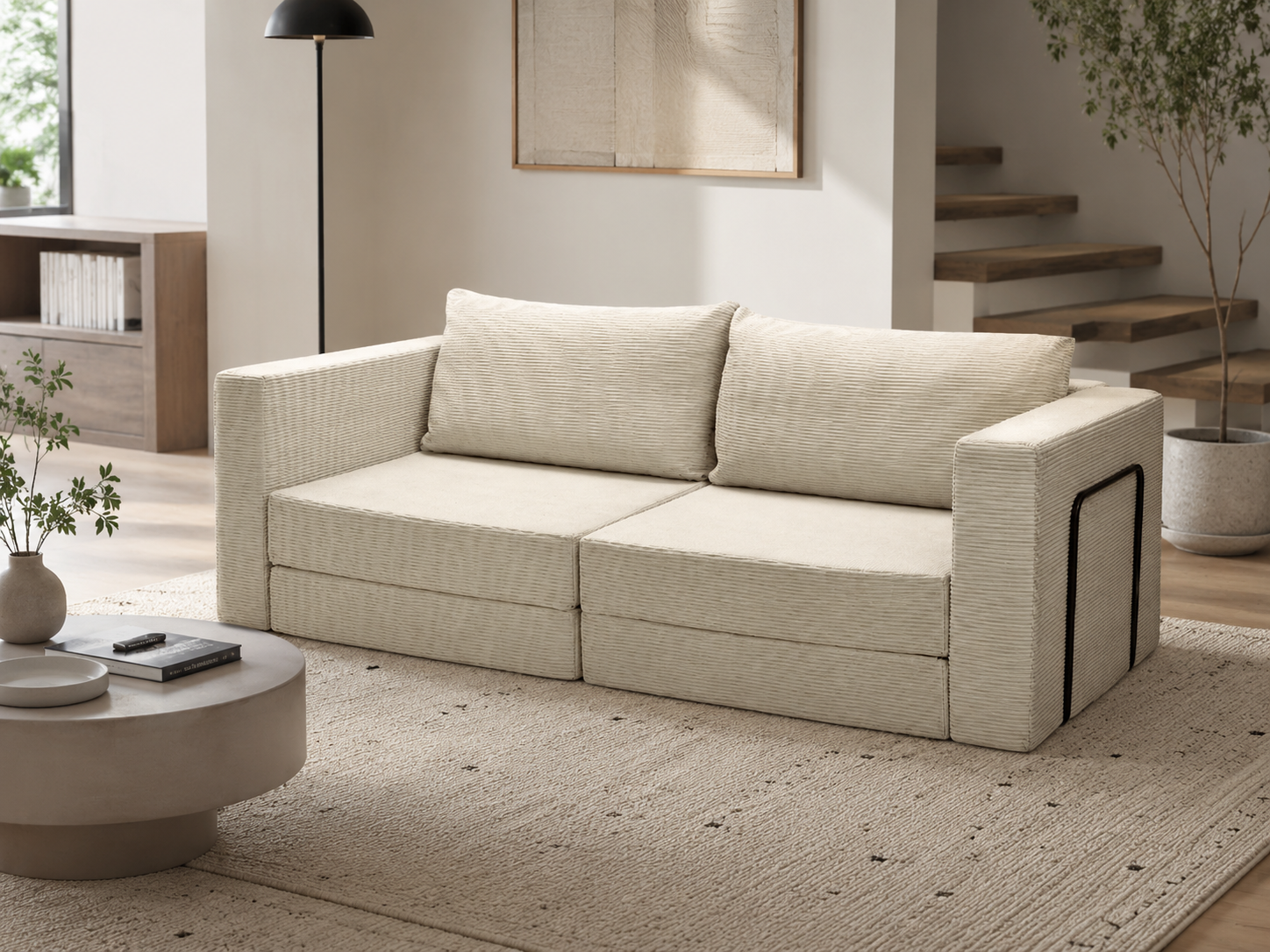
The Smart Choice: The Flow Sofa by SEESOFA
If you want to skip the guesswork and invest in a piece built to exact specifications, the Flow Sofa from SEESOFA is a benchmark choice.
The Flow is built around a three-layer sofa foam filling system:
-
The Base: A 40 kg/m³ high density foam sofa core for structural support.
-
The Transition: An open-cell HR foam layer for responsive bounce-back.
- The Comfort Layer: A memory foam top surface that relieves pressure points.
Seat cushions test at an ILD of 38 — medium-firm, suitable for most body types, and resistant to the "bottoming out" sensation that cheaper options can't avoid. The solid beech frame is corner-blocked and backed by a 15-year warranty. The entire foam seat sofa features covers that zip off completely and are machine washable.
Available in Full and Queen sizes with five fabric options across neutrals and earth tones, the Flow functions as a day-to-day sofa and converts to a bed via a patented glide mechanism — smooth, single-motion, no heavy lifting.
For anyone searching for a foam sofa that handles real daily life without compromise, the Flow by SEESOFA is one of the most honestly specified options available today. The numbers are published, the construction is transparent, and the result is a sofa that earns its place in your home rather than just filling space in it.

Frequently Asked Questions
1. What foam type is best for a sofa?
High Resilience (HR) foam is one of the best choices because it is durable, airy, and keeps its shape well.
2. Is memory foam good for sofas?
Yes, especially as a top comfort layer. It gives pressure relief but works best with a firmer base underneath.
3. What foam density should I look for?
For seat cushions, choose at least 30 kg/m³. A good high density foam sofa usually uses 35-45 kg/m³.
4. How long does a good foam sofa last?
A quality high-density foam sofa can keep its shape for around 7-10 years or longer.
5. What makes a foam sofa durable?
Durable foam, a strong hardwood frame, good suspension, solid legs, and quality upholstery all matter.
6. Is the Flow Sofa by SEESOFA a good choice?
Yes, it is presented as a strong option thanks to its layered foam system, beech frame, washable covers, and sofa bed function.


Leave a comment
This site is protected by hCaptcha and the hCaptcha Privacy Policy and Terms of Service apply.