

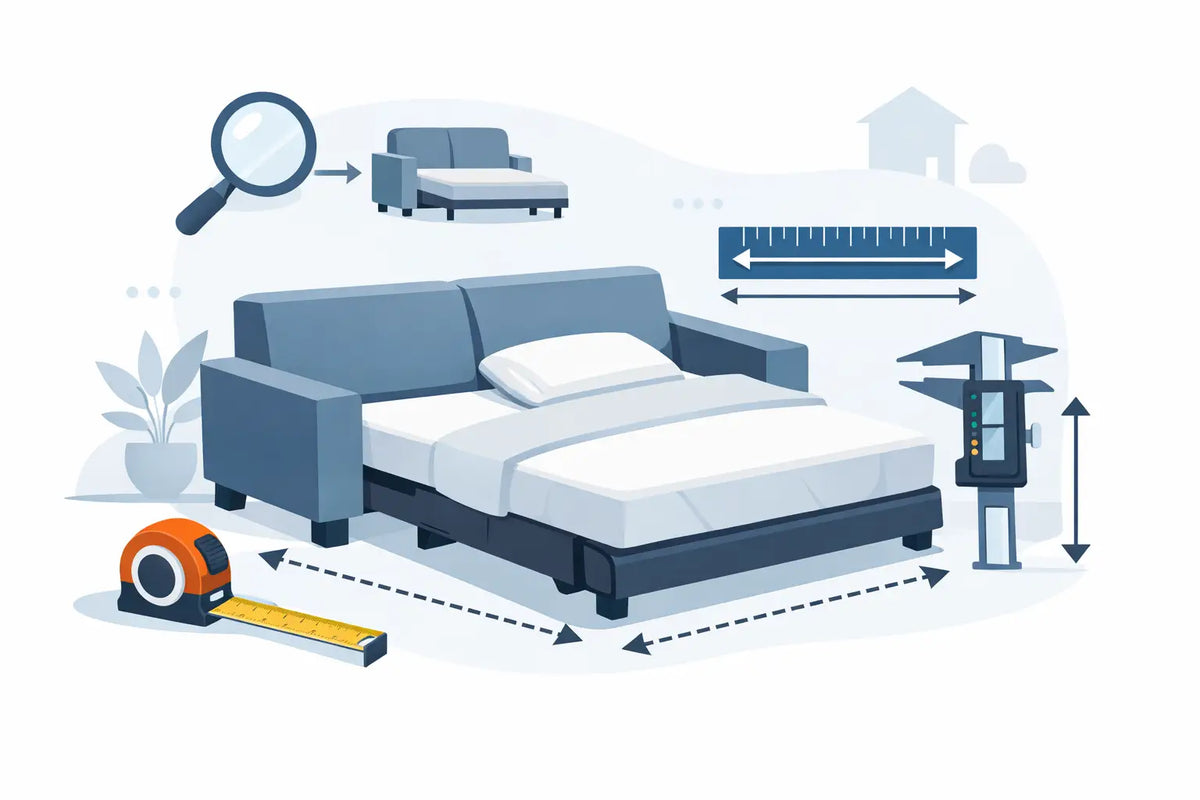
That sofa bed can look perfectly proportioned online, then arrive with an open sleeping footprint that takes over the room. Knowing how to measure sofa beds before you buy helps you choose a configuration that works for everyday lounging, overnight guests, and the route from the delivery truck to your living room.
A good fit is more than the width of an empty wall. You need to account for the sofa in its closed position, its full size when opened, the space people need to walk around it, and the practical realities of doors, stairs, elevators, and turns. A few careful measurements now give you much more freedom to design the room your way.
Start With the Room, Not the Sofa
Before comparing sofa bed dimensions, measure the area where it will live. Use a tape measure, then write down the room’s width and length, the wall you plan to use, and the distance to nearby furniture. If the space has a radiator, window ledge, floor vent, outlet, or baseboard heater, measure its position too.
Think about how the room works on an ordinary Tuesday, not only when guests stay over. Does someone walk through this area to reach a balcony, hallway, or kitchen? Does a coffee table need to remain in place? Is there a rug you want the sofa to sit on? Those details determine whether a sofa bed feels naturally integrated or constantly in the way.
Mark the intended footprint on the floor with painter’s tape. Tape the closed dimensions first, then extend the tape to represent the bed when opened. This simple step makes the scale real. You can see whether the bed blocks a doorway, crowds a dining table, or leaves enough floor space to get up comfortably in the morning.
How to Measure Sofa Beds in Two Positions
Every sofa bed has two essential sets of measurements: closed and open. Both are equally important.
Measure the closed sofa dimensions
When the sofa is set up for seating, record its overall width, depth, and height. Overall width is the measurement from the outermost point on one side to the outermost point on the other. This may include arms, side panels, or any modular sections, so do not assume that seat width and overall width are the same.
Depth runs from the front edge to the back. It tells you how far the sofa projects into the room and whether it will preserve a comfortable walkway. Height is typically measured from the floor to the top of the backrest. While height does not usually affect floor planning, it matters below windows, shelving, wall art, and sloped ceilings.
Also check seat height and seat depth if comfort is a priority. A deeper seat can feel relaxed and lounge-ready, while a more compact seat depth may suit a smaller room or a more upright sitting style. There is no universal best choice. Your height, your preferred posture, and how you use the space all matter.
Measure the open bed dimensions
Next, measure the sofa bed in its sleeping position. Record the open length from the back of the sofa to the furthest point of the extended bed, plus the sleeping width. Confirm the usable mattress or foam sleeping area separately from the overall open footprint, especially if arms or side bolsters extend beyond the bed.
The open length is often the measurement people miss. A sofa bed may fit beautifully against a wall while closed, yet project far enough into the room to block circulation when opened. If your guests will use the bed for more than one night, plan for enough space to enter and exit from at least one side without climbing over someone.
As a practical rule, aim for roughly 24 to 30 inches of clear walking space along the main route around the open bed where your layout allows. In compact apartments, you may need to work with less, but test that tighter clearance with tape before committing. A layout can be technically possible and still feel frustrating at bedtime.
Include Clearance for Doors, Drawers, and Daily Movement
A sofa bed should not turn your living room into an obstacle course. Measure the swing of every nearby door, including closet doors, bedroom doors, and the front door if it opens into the space. Do the same for media units, cabinets, drawers, and storage benches that need room to open.
Consider the furniture that may move when the bed is in use. A lightweight coffee table can be easy to shift, but only if you have somewhere sensible to put it. An oversized ottoman may work as flexible seating, a footrest, or a bedside surface, yet it still needs a home when the bed is open.
If you are furnishing a studio, guest room, or multipurpose home office, identify the non-negotiables first. That might be access to a desk, a closet, or a bathroom door. Design around those functions, then choose the sofa bed size that supports them. Flexibility works best when it is planned, not improvised every time someone stays over.
Measure the Delivery Path Before Ordering
The room dimensions can be perfect, but the sofa still has to get inside. Measure the full delivery route from the building entrance to its final location. Include exterior gates, entry doors, apartment doors, hallways, stairwells, elevator interiors, and sharp turns.
For each doorway, measure both the width and height of the clear opening. Do not rely on the size of the door itself. Trim, handles, handrails, and partially opening doors can reduce the usable space. For hallways, measure the narrowest point. For staircases, note the width, ceiling height, and the size of the landing where a delivery team needs to turn.
Elevators need three measurements: interior width, interior depth, and door opening height and width. A piece may fit through the elevator door but still be too long to rotate inside the cab. If your building has rules about delivery times, elevator reservations, or protective coverings, arrange those details early.
Modular and foam sofa beds can make access easier than a single heavy, fixed-frame piece. Separate sections are generally simpler to carry, position, and reconfigure. Still, always compare the dimensions of each delivered section with your actual route. “It should fit” is not a delivery plan.
Account for Modular Configurations and Moving Parts
With a modular sofa bed, measure the configuration you want, not only the individual module. A chaise, corner section, armless seat, or ottoman changes both the seating footprint and the way the bed opens. If you may move the chaise from one side to the other later, test both layouts on the floor.
Also leave room for the conversion mechanism or folding sections to move freely. Nothing should catch on a coffee table, radiator, low shelf, or thick rug edge as you open the bed. If your rug is especially plush, consider whether it could interfere with stability or make the transformation less smooth.
This is where customizable furniture earns its place. A smaller configuration may preserve flow in a city apartment, while a wider modular setup can create a generous guest bed in a family room. Your ideal size depends on whether the sofa’s primary job is daily seating, frequent hosting, or a balanced mix of both.
Check the Bed Size Against Real Sleep Needs
Do not choose a sofa bed based on labels alone. “Double,” “queen,” and “full-size” can describe different usable sleeping dimensions depending on the design. Look at the actual length and width of the sleeping surface, then compare them with the needs of the people most likely to use it.
For one adult guest, a compact sleeping area may be completely comfortable and leave more space for daily life. For couples or taller guests, prioritize width and length, even if that means choosing a larger room placement or moving another piece of furniture. Comfortable sleep is part of the point.
Think about bedding, too. Measure where folded bedding, pillows, and a throw will live when the sofa is in seating mode. Removable, washable covers are especially useful in a sofa bed that serves both busy daily life and overnight hosting, since the piece naturally works harder than a sofa used only for sitting.
Create a Simple Measurement Plan
Keep your notes in one place before comparing options. You need the maximum closed width and depth, the maximum open length and width, the preferred walking clearance, and the smallest dimensions along the delivery route. Add a quick sketch of the room, even if it is just a rectangle with doors and windows marked in.
Then use painter’s tape or newspaper to test the footprint at full scale. Walk through the space with the taped bed open. Sit where you would normally sit. Open the nearby door. Imagine carrying a glass of water past it at night. This is the difference between selecting furniture that merely fits and choosing a sofa bed that supports the way you live.
A sofa bed should give your room more possibilities, not more compromises. Measure both versions of the piece, protect the pathways you use every day, and let the final layout leave room for comfort, guests, and your own vision of home.

Leave a comment
This site is protected by hCaptcha and the hCaptcha Privacy Policy and Terms of Service apply.