

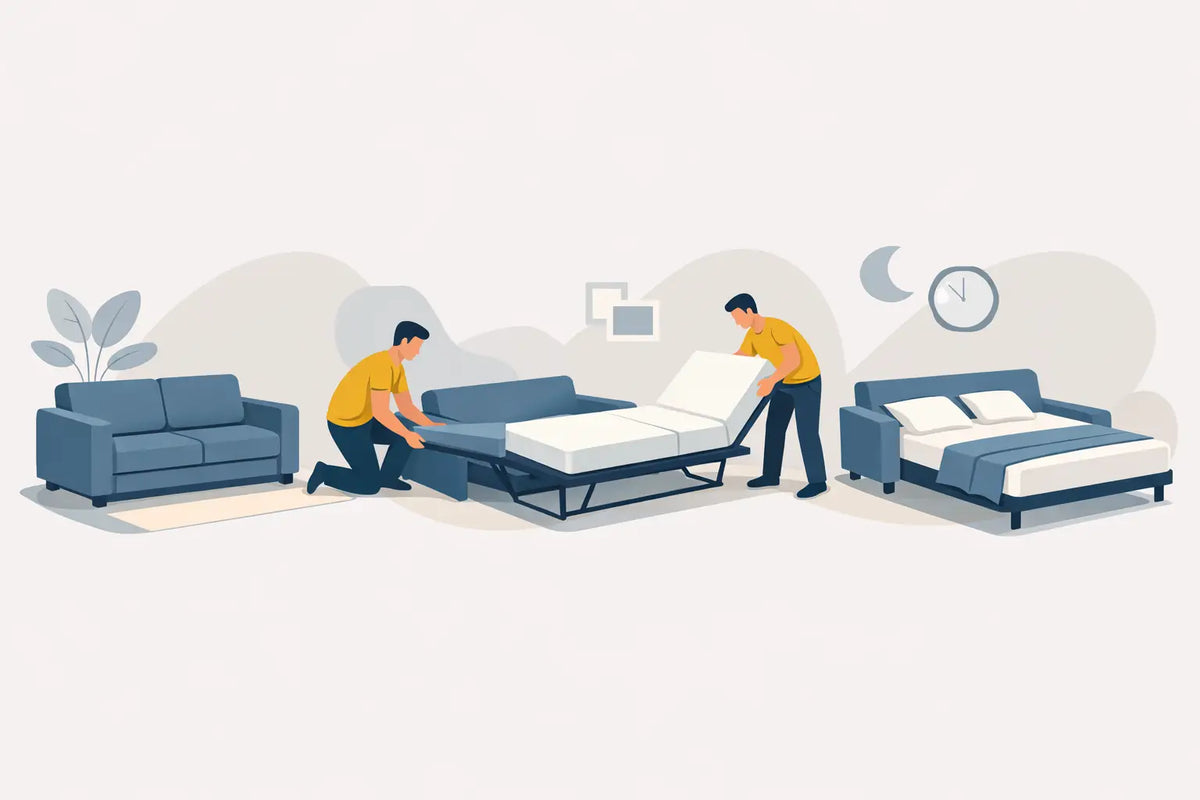
A guest arrives late, your spare room is already doing double duty as an office, and the sofa suddenly needs to become a real place to sleep. Knowing how to convert a sofa bed before that moment makes hosting feel easy instead of awkward. The right process protects the mechanism, keeps fingers clear, and helps your guest wake up feeling rested.
Not every sofa bed opens the same way. A pullout sleeper has a concealed frame and mattress. A click-clack model folds flat by changing the backrest position. A foam sofa bed may unfold, flip, or rearrange into a sleeping surface without a heavy metal mechanism. Start with the design in front of you, then move slowly and let the furniture do the work it was designed to do.
Before You Convert the Sofa Bed
Give yourself room to work. Move coffee tables, ottomans, side tables, and anything breakable out of the opening path. If your sofa bed sits on a rug, make sure the rug will not bunch under the legs or catch on a pullout frame. This small step prevents scratched floors, strained hardware, and a lot of unnecessary wrestling.
Remove decorative pillows, throws, and loose seat cushions first. Some designs store their sleep surface beneath the cushions, while others use cushions as part of the bed. If you are unsure, avoid forcing a seam, lifting a panel by one corner, or pulling on fabric tabs that are meant only for positioning.
It also helps to check the bed's surrounding clearance. A sofa may look compact during the day but extend several feet into the room at night. Measure from the front edge of the sofa to the nearest wall or furniture piece if space is tight. You want enough room to open the bed fully and walk around it safely.
Check the Manufacturer's Instructions
Your sofa bed's care guide is more useful than most people realize. It tells you where to lift, pull, release, or fold, as well as the maximum weight capacity and any mattress or cushion placement details. This matters most with pullout frames, where a release bar or locking joint may not be obvious.
For modular or foam-based designs, the instructions can clarify the intended configuration. The most comfortable bed setup is not always the first arrangement that seems possible. Use the recommended layout to keep the surface level and the pieces stable.
How to Convert a Sofa Bed Step by Step
The general goal is simple: clear the area, release the sleeping section, extend or unfold it evenly, then check that every support point is secure. The details change by style.
1. Clear and prepare the seating area
Take off all nonessential cushions and place them somewhere clean and dry. If the sofa uses removable covers, there is no need to remove them for normal conversion. Keep bedding nearby so you do not have to climb over the open bed once it is set up.
If you have hardwood, tile, or delicate flooring, consider placing felt pads under legs that shift during conversion. Never drag a metal frame across the floor. Lift from both sides with another person if the frame is heavy.
2. Find the opening point
On a pullout sofa bed, look between or beneath the seat cushions for a handle, fabric loop, or front rail. Pull straight outward with both hands when possible. The hidden frame should glide forward rather than twist to one side.
On a click-clack sofa, the opening point is usually the backrest. Pull or lift the backrest gently until you feel it release from its upright setting, then guide it down into the flat position. Different models have different locking sequences, so stop if you meet resistance instead of applying more force.
On a fold-out foam sofa bed, the seat and back sections may simply unfold onto the floor. Start at the section designed to move first, then open each panel in order. Keep the foam aligned as you go so the sleeping surface stays flat.
3. Extend the bed evenly
This is the step where rushing causes most problems. With a pullout frame, walk backward as you lift and extend, holding both sides of the frame at roughly the same height. Once it is fully extended, lower the legs carefully until they contact the floor.
Check every leg before putting weight on the mattress. A leg that is folded under, resting on a rug edge, or not fully locked can make the bed feel uneven and put stress on the frame. If the frame has center supports, make sure they are also down and firmly planted.
For a foam sofa bed, smooth each fold and press the sections together. A lightweight foam construction is easier to handle than a traditional sleeper mechanism, but the pieces still need to sit flush. If one section is slightly angled, reopen it and reset it rather than trying to sleep on an uneven surface.
4. Set up the mattress or sleep surface
Pullout sleepers usually have a thin folding mattress. Unfold it completely, center it on the frame, and smooth out any bends from storage. If the mattress has a designated head end, place it correctly before adding sheets.
A mattress topper can improve comfort on some traditional sleeper sofas, especially for adults staying more than one night. Choose a slim, flexible topper that can be stored separately. A thick topper may make closing the sofa difficult and should never be left inside unless the manufacturer specifically says it is safe.
With a foam sofa bed, use fitted sheets or a flat sheet over the full surface. The best setup depends on the design and dimensions. A fitted sheet can help hold the pieces together, while a flat sheet offers more flexibility for unusual or modular layouts. Add a breathable blanket and supportive pillows, and the space will feel much closer to a proper bed than a last-minute backup.
5. Test stability before your guest uses it
Sit on the edge of the open bed, then lie down briefly and shift your weight. Listen for squeaks, feel for dips, and check that the center does not bow. A little movement can be normal with a metal sleeper frame, but wobbling, a tilted surface, or a support leg that moves needs attention before anyone sleeps on it.
If the bed does not feel right, close it partway and inspect the setup. Look for trapped cushions, uneven flooring, bent bedding, or a support leg that has not fully opened. Do not try to repair a damaged mechanism while it is under tension. Close it carefully, remove the load, and follow the manufacturer's service guidance.
Make Your Sofa Bed More Comfortable
Conversion is only half the experience. Small choices can make a major difference for overnight comfort, particularly in a small apartment or multifunctional room.
Start with clean bedding that fits the actual sleep surface. Sheets that are too small will pull loose at the corners, while oversized bedding can bunch around folding sections. If your guest is sensitive to pressure points, add a quilted pad or slim topper where appropriate.
Temperature matters too. Sofa beds are often positioned against a wall or in the main living area, where airflow, streetlight, and household noise can be different from a bedroom. Offer an extra blanket, a phone charging spot, and a clear path to the bathroom. Those details make a flexible room feel thoughtfully prepared.
For foam designs, inspect the cover before and after use. Removable washable covers are especially practical in homes with pets, children, frequent guests, or everyday coffee-on-the-sofa life. Treat small spills promptly, use the care instructions for your specific fabric, and allow covers to dry completely before putting them back on.
Closing the Bed Without Damaging It
Closing follows the same principle as opening: remove bedding, work evenly, and never force the mechanism. Take off sheets, pillows, toppers, and blankets before folding a traditional pullout mattress. Leaving bulky bedding inside can obstruct the frame and wear down the fabric over time.
For a pullout model, lift the frame slightly from both sides to fold the support legs inward. Guide the mattress back into its folded position, then push the frame toward the sofa until it is fully seated. Keep hands away from hinges and pinch points, especially near the front rail.
For a click-clack or foam sofa bed, reverse the opening sequence and make sure each section lands in its intended seat position. Replace cushions only after the frame or foam panels are completely settled. If cushions look uneven afterward, give them a quick fluff and reposition them rather than pressing them into place.
A sofa bed should support the way you actually live: relaxed evenings, unexpected guests, movie nights, and rooms that need to change purpose without changing your style. Once you know its conversion rhythm, setting up a comfortable sleep space becomes one more easy part of making the room your own.


Efterlad en kommentar
Denne side er beskyttet af hCaptcha, og hCaptchas Politik om beskyttelse af persondata og Servicevilkår er gældende.